


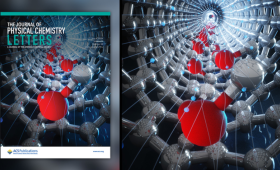
LLNL scientists and a collaborator at University of Texas at Austin turn to simulations to explain the first-order response of confined water to applied electric fields.
Science and Technology Highlights

LLNL researchers make advancements in understanding and resolving the long-standing "drive-deficit" problem in indirect-drive ICF experiments.
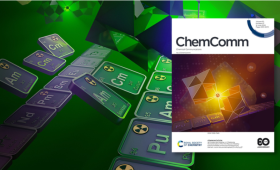
LLNL researchers develop a new technique for synthesizing molecular compounds with heavy elements.
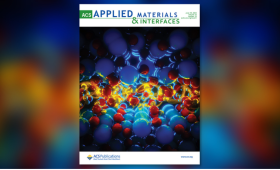
LLNL Researchers discover a new mechanism that can boost the efficiency of hydrogen production through water splitting.
LLNL scientists report advancements in understanding plasma pressure profiles within flow-stabilized Z-pinch fusion, a candidate for achieving net gain fusion energy in a compact device.

An instrument designed and built by LLNL researchers is the highest-resolution gamma ray sensor that has ever flown in space.

LLNL mathematician and collaborators publish a recent paper introducing specialized solvers optimized for simulations running on graphics processing unit (GPU)–based supercomputers.

LLNL researchers and collaborators unlock new secrets about the interiors of super-Earth exoplanets, potentially revolutionizing our understanding of these distant worlds.
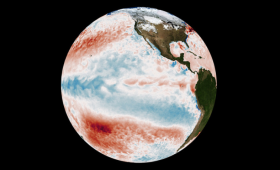
LLNL scientist and collaborators find the unique temperature trend patterns associated with natural climate variability for 1980–2022.

LLNL and BridgeBio announce the commencement of clinical trials for a first-in-class medication that targets specific genetic mutations implicated in many types of cancer.