


Two Livermore-led teams received SciVis Test of Time awards for papers that have achieved lasting relevancy in the field of scientific visualization.
Science and Technology
in the News
Science and Technology
in the News
News Center
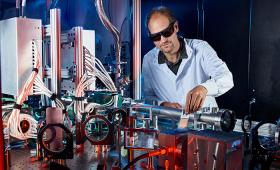
Spiral phase mirrors, when incorporated into a laser system, will enable scientists to “twist” the laser light and generate an optical vortex.
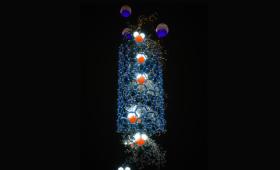
To transform the way energy is collected, stored, and used, the Office of Basic Energy Sciences (BES) awarded Livermore and collaborators three energy-focused projects.
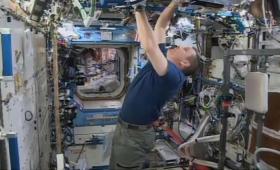
A five-year microbial study of the International Space Station and its astronauts by Lawrence Livermore and NASA researchers has found that the ISS habitat is safe for its residents.
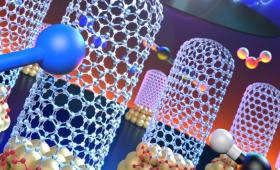
Livermore scientists are scaling up the production of vertically aligned single-walled carbon nanotubes (SWCNT) that could revolutionize a diverse set of commercial products.
The United Nations Intergovernmental Panel on Climate Change, to which LLNL climate scientists have contributed, was jointly awarded the Gulbenkian Prize for Humanity.
Two Lawrence Livermore scientists have been selected as 2022 fellows of the American Physical Society.
Livermore researchers are using the third generation of early access machines to port codes over to the future exascale system El Capitan.
Bruce Remington has been honored with the American Physical Society’s 2023 George E. Duvall Shock Compression Science Award.
Livermore scientists have devised a method to fabricate all-solid-state lithium metal batteries.