


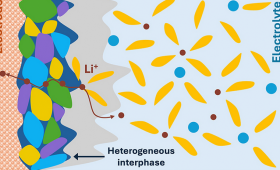
In a recent study, published in Advanced Energy Materials, researchers at LLNL used large-scale molecular dynamics simulations accelerated by machine learning, combined with data-driven analysis, to tackle this challenge.
Science and Technology
in the News
Science and Technology
in the News
News Center
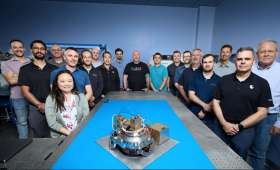
A team of scientists at LLNL partnered with Rocket Lab and the U.S. Space Force (USSF) Space Systems Command (SSC) to deliver an optical payload for the VICTUS HAZE tactically responsive space (TacRS) mission under the Space Safari program office.

A team of LLNL scientists and engineers pushed the limits of unmanned aerial systems to earn a place at the DARPA Lift Challenge, hosted by the Defense Advanced Research Projects Agency (DARPA).

In a new study, published in Physical Review Letters, researchers at Lawrence Livermore National Laboratory (LLNL) and the Ion Storage Group at the National Institute of Standards and Technology in Boulder, Colorado, created a robust process for entangling trapped-ion qubits.

Through a Strategic Partnership Project with micronuclear reactor startup AMPERA, LLNL engineers are applying a novel metallic-particle manufacturing capability toward producing this robust nuclear fuel.
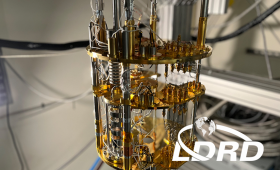
In a new experimental campaign called Magnetometry for Neutrino physics (Magneto-ν), scientists at LLNL are searching for the sterile neutrino using nuclear beta decays of plutonium-241.
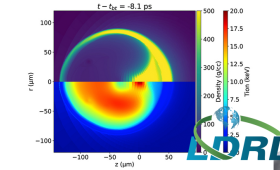
Researchers at LLNL have found that implosions designed for inertial fusion energy (IFE) can tolerate significant imperfections before performance abruptly declines, a finding that could inform the design of fuel targets for future fusion power plants.

LLNL scientists and engineers have earned six R&D 100 Awards, which recognize the top 100 inventions worldwide. LLNL was the lead laboratory on four of the winning inventions and contributed to two multi-lab invention wins.
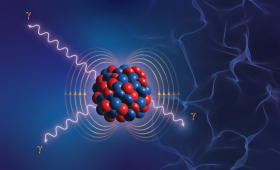
A new study from an international scientific team led by the Facility for Rare Isotope Beams (FRIB) and LLNL was published in Nature, and work sheds light on the internal structure of atomic nuclei and has far-reaching implications for national security and astrophysics.
In a new study, published in Nature Physics, researchers at LLNL document how diamond melts under pressures three times greater than the conditions at the Earth’s core.