


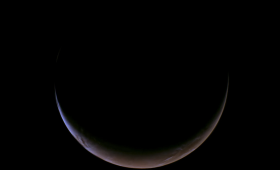
On a multi-billion-mile journey to the asteroid Psyche, a gamma-ray sensor developed by a team at LLNL took its first measurements of a planetary surface after 2.6 years in deep space.
Science and Technology
in the News
Science and Technology
in the News
News Center
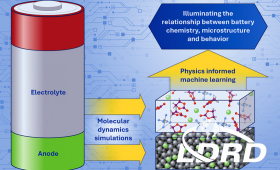
In two recent publications, LLNL researchers examined how integrating molecular dynamics simulations with physics-informed machine learning can illuminate the relationships between structure and behavior in complex battery materials.
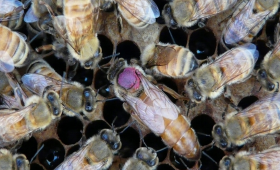
LLNL and U.C. Davis researchers showed that a honeybee queen facing chronic exposure to pesticides will take up that contamination and pass it along to her eggs, a process called maternal offloading.
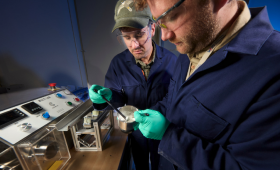
A team of researchers at LLNL is working on an initiative called Project MAHEM — A Modern Approach to HE (high explosive) Manufacturing — to address those weaknesses by building a stronger scientific foundation for explosive formulation and pressing.
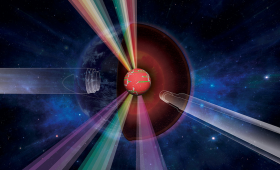
Researchers from LLNL and several universities used the National Ignition Facility (NIF) to recreate extreme temperature and pressure conditions of the Earth’s inner core. This enabled the first ever simultaneous measurement of iron’s dynamic strength at relevant temperature and pressures.

A new study published in mSystems by researchers at LLNL shows that of the many viruses present in soil, only some are active participants at any given time. Over three quarters of the viruses in the study were dormant lurkers, persisting in the soil and biding their time for suitable conditions to emerge.

In new research published in Nature Photonics, scientists from LLNL and the University of California, Irvine demonstrated the first high-intensity “light spring” laser.
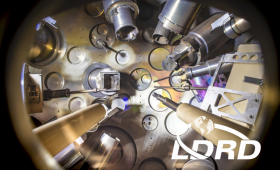
Research, conducted by scientists at LLNL, the University of California, Berkeley, the French Commissariat à l’Énergie Atomique et aux Energies Alternatives (CEA) and the University of Rochester’s Laboratory for Laser Energetics (LLE), shows that helium reacts differently from the predictions of most broad-range theoretical models.
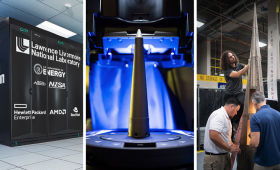
LLNL is contributing AI-enabled payload optimization and advanced modeling and simulation expertise to Aires Tide, a collaborative National Nuclear Security Administration (NNSA) demonstration exploring new ways to design flight test vehicles.
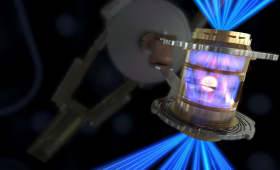
LLNL scientists have calculated that small changes in wavelengths would make NIF optics more resilient to filamentation damage.